
Why Voting Matters: America's 250-Year Fight for the Ballot
The United States stands as one of history’s most enduring democracies. In a nation built on the premise of a fair and just democracy for all, civic engagement remains the core of the American ethos.
As we celebrate the 250th anniversary of the US, the BallotReady team is reflecting on what the franchise means, and how we can ensure every American has a voice.
In 1776, the Founding Fathers envisioned a “just” democracy for all, but this promise was initially limited. Then, only land-owning white men were granted the right to vote. Over the years, through various amendments to the Constitution and laws enacted, the American voting populace has expanded:
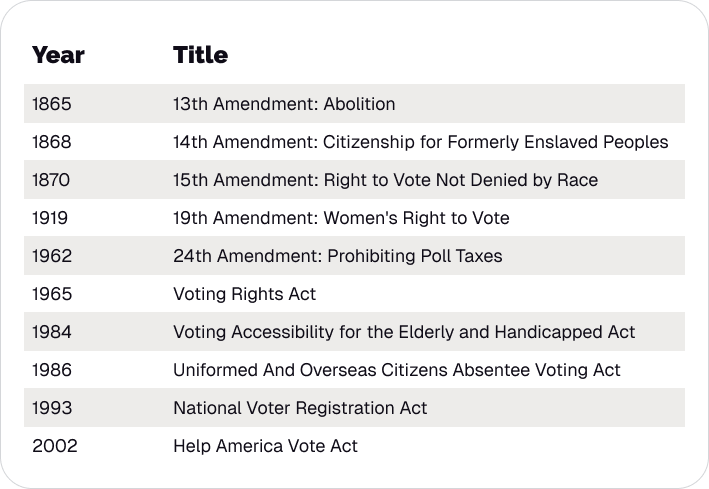
See References for more information.
Voting Is Democracy in Action
In a true democracy, the act of voting serves as the fundamental form of political expression.
From international treaties to local zoning commissions, every election impacts our lives. Voting allows citizens to communicate the issues they care about, who they want to represent them, and how they wish to be governed. By participating in our democracy, voters play a critical role in determining how just and equitable our nation is.
As the Legal Defence Fund explains, “[Federal], state, municipal, and county-level elected officials determine policies surrounding health care, education, zoning, economic development, environmental policy, infrastructure, law enforcement, tenants’ rights and so much more.”
The following offices are some of the many that appear on your ballot and carry significant power in shaping the quality of your daily life:
District Supervisors
School Board Members
Mayors
Sheriffs
Members of Congress
Governors
Vice President
President
The Link Between Voting and Stronger Communities
Research from the Institute for Responsive Government confirms that increased levels of voter turnout correlate with improved resource allocation and policy priorities at the federal, state, and local levels. Increased voting is also linked to higher earnings, increased education levels, better health outcomes, and lower rates of arrest and incarceration.
The Institute's findings also suggest that communities with increased access to voter registration and voting enjoy greater social cohesion, improved community conditions, and better health overall.
Voter Suppression Tactics on the Rise, and How to Fight Back
A healthy democracy depends on increased civic participation, and the legitimacy of US democracy depends on its citizens' right and ability to vote.
Unfortunately, voter suppression has intensified in recent years, manifesting as:
Strict(er) voter ID laws
Cuts to early voting
Restricted voter registration
Purging voter rolls
Rule changes for vote-by-mail deadlines
For our team at BallotReady, these attempts to suppress voters only serve as fuel to our mission. We envision a world where all people can fully participate in civic life, and we believe that increased civic engagement is the cornerstone of a resilient democracy.
Whether you're preparing to vote, considering a run for office, or seeking to engage more deeply with your elected officials, we aim to provide you with the tools and information you need. That way, together, we can build a stronger democracy for all.
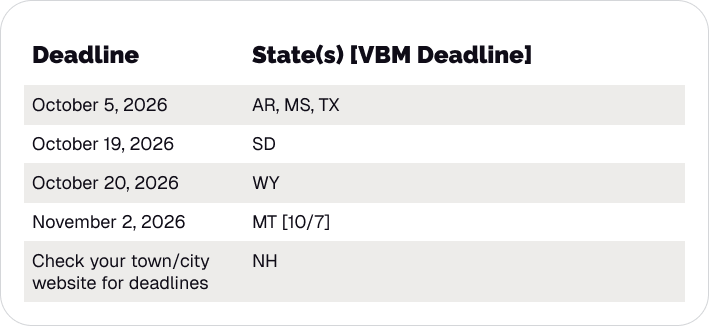
Want to get involved? Vote! Find the 2026 Midterm Registration Deadlines below.
Online, In-Person, and Vote-by-Mail registration dates, unless otherwise noted:
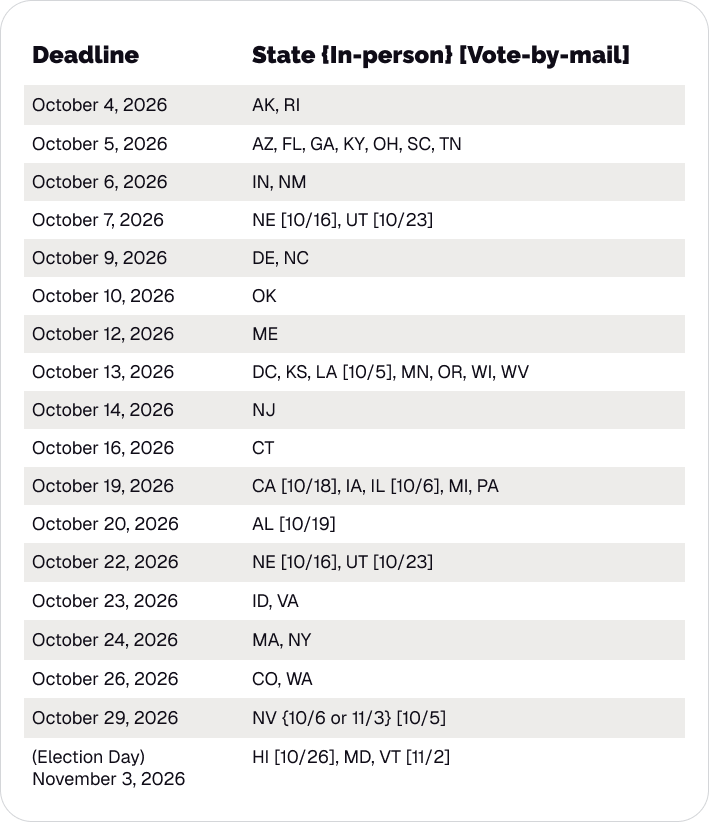
The following states only have in-person and/or VBM registration. Their deadlines are as follows:
ND: Voter registration is not required
Want to learn more about how you can help ensure that you and your community have the necessary resources to stay engaged? Visit https://www.ballotready.org/ for more information.
References for Chart #1